
Build Notes
Building MY/SG SEO Checker: A Safe First-Pass SEO Audit
An internal product build note about a read-only first pass for public webpages, with transparent checks and no ranking, traffic or full-site diagnosis claims.
Live first-party scans: 24 August 2026
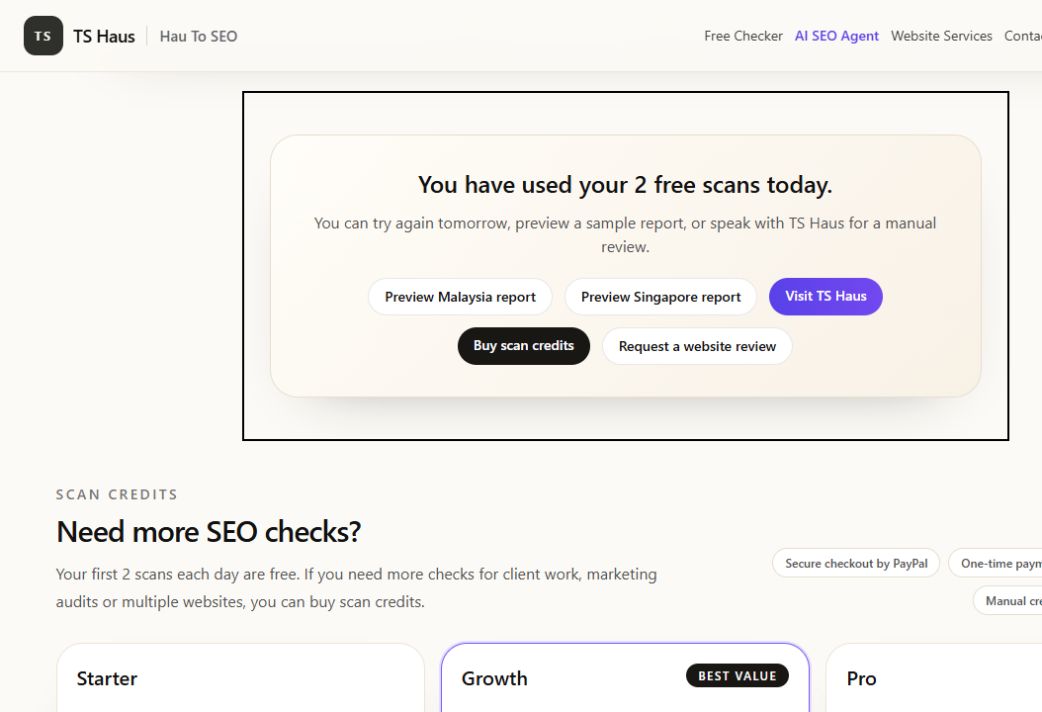
We used the live checker normally against TS Haus-controlled public pages. Two completed scans were available under the product’s stated two-free-scans-per-day browser allowance; a third normal attempt on seo.tshausdigital.com correctly stopped at the daily limit. We did not bypass that limit.
| URL tested | Observed result | Evidence boundary |
|---|---|---|
| tshausdigital.com | 91 overall; 0 critical issues; 49 passed checks; PageSpeed unavailable. | One H1, canonical and sitemap availability were correctly found. Unavailable PageSpeed data was not converted into a low score. |
| matchhaus.tshausdigital.com | 78 overall; 1 critical issue; 40 passed checks; PageSpeed unavailable. | The fetched HTML had no H1 and local-business signals were missing. This is a first-pass observation, not a Google ranking verdict. |
| seo.tshausdigital.com | Daily scan limit reached after two completed scans. | The current browser-local free allowance is a real availability boundary, not a scan result. |
1. The problem and target user
Founders and SME operators often need to know whether one public page has obvious problems before commissioning a broader crawl or expert review. The checker reviews visible and machine-readable signals such as titles, descriptions, headings, canonicals, crawl directives, images, structured data, robots, sitemap discovery and local business signals for Malaysia or Singapore.
It does not crawl an entire site, inspect backlinks, track keywords or know how Google will rank a page. Its job is triage: find common issues, distinguish what was not tested and support a sensible next review.
2. Why TS Haus built it
The product turns a recurring first-step website review into a repeatable internal tool. Local checks include Malaysia or Singapore wording, contact routes, local phone patterns, WhatsApp, service-area language and supported business structured data. A score helps prioritise; it cannot judge market competition, offer quality, domain authority or commercial keyword value.
3. Product and scoring decisions
- A server route validates the URL and selected country before invoking the audit pipeline.
- The baseline checks parse returned HTML and use rule-based logic rather than an AI API.
- Fixed penalties and documented category weights make the product score reproducible, but it remains a heuristic rather than a search-engine score.
- When PageSpeed is unavailable, performance is marked not tested and the total is reweighted across categories that were tested.
- The browser allowance of two free scans per calendar day avoids accounts but is not durable server-side abuse protection.
4. URL fetching needed explicit safety controls
- Allow only HTTP and HTTPS and reject embedded credentials.
- Block localhost and private or internal IP ranges.
- Resolve hostnames before fetching and recheck redirects.
- Cap redirect hops, reject non-HTML responses and limit the response body.
- Apply a small concurrency ceiling around external requests.
Network safety is ongoing maintenance because URL parsing, DNS behaviour and hosting environments change. A public URL submitted for scanning reaches the TS Haus server and may appear in infrastructure request metadata; this note does not claim zero logs.
5. Reliability and privacy boundaries
The checker reads server-returned HTML and does not render or modify the target site. Client-rendered content can therefore be missed. Some sites block automated requests, so a failed scan does not prove that the site is broken. The baseline has no account or saved-report history, while optional third-party checks have their own processing boundary.
6. Known limitations and operational risks
- One fetched HTML page, not a full-site crawl.
- No backlink database, keyword tracking, account history or complete market analysis.
- JavaScript-rendered content may be absent from the fetched HTML.
- PageSpeed data may be unavailable and target sites may block or delay requests.
- The browser-local usage allowance can be reset or bypassed.
- The score does not guarantee ranking, traffic, indexing or business results.
7. What we learned
Fast should describe the intended first-pass experience, not promise that every external server responds on time. Failed, not tested and needs attention are different states. Local relevance is most honest as transparent checks rather than a claim that a local label improves rankings.